grill-me sharpens a plan by interview. Its own description calls it "a relentless interview to sharpen a plan or design."
The whole Skill is one line: it calls the grilling Skill, which runs the interview. So grill-me is a named way in to grilling. The agent asks you questions in rounds until you both reach a shared understanding.
When to use it
Use it when there is no repo under the thing you want to sharpen. Matt lists "a plan, a design, a piece of writing, anything with no repo under it."
For example, Matt has used it for "figuring out what course to build next". He says people use it "for business decisions, for writing, and for what to do next".
When not to use it
You are in a repo. Use grill-with-docs instead. It runs the same interview, and it also writes GLOSSARY.md and ADRs as you go. (An ADR, or architecture decision record, is a short file that records one hard-to-reverse decision.) Matt calls grill-with-docs "strictly the better one" whenever a repo is there.
The answers are in someone else's head. Use to-questionnaire. It is the inverse of grill-me: it writes a questionnaire for that person to fill in.
it writes a questionnaire for that person to fill in
Use it when there is no repo under the thing you want to sharpen.
What it needs to start
Only you and a plan or idea. No repo, files or Issues are needed.
You start it yourself by typing /grill-me. The Skill is marked disable-model-invocation: true, which means the agent never starts it on its own.
What it creates
A shared understanding between you and the agent, and nothing on disk. grill-me is stateless: it "saves nothing locally and builds no GLOSSARY.md." It creates no files, Issues, branches or pull requests.
If you find yourself wanting the decisions written down, that is a sign you wanted grill-with-docs.
Going deeper
5 min read · Going deeper not read
Why it exists
On 2026-03-16 Matt named the problem in his "5 Agent Skills I Use Every Day" post: "Claude Code tends to spit out a plan really early when in plan mode, creating a document before we've truly understood each other. But the grill me skill forces that conversation."
A week later, on 2026-03-23, he tied it to an older habit: "Before AI came along, devs called this rubber ducking", talking an idea through until you find all its cases.
How much of a plan do you need first? SKILL.md's description, written on 2026-05-31 and unchanged at the Course's pin commit, calls it a "relentless interview to sharpen a plan or design", and the SKILL.md decides what the Skill does. Matt's page, updated later on 2026-08-24, adds context: grill-me "takes a loose idea and interviews you until you can commit to it." And: "You do not need a worked-out plan to start", because the session exists to produce one. His March post said the same: you can start with "just a vague couple of sentences".
How it works underneath
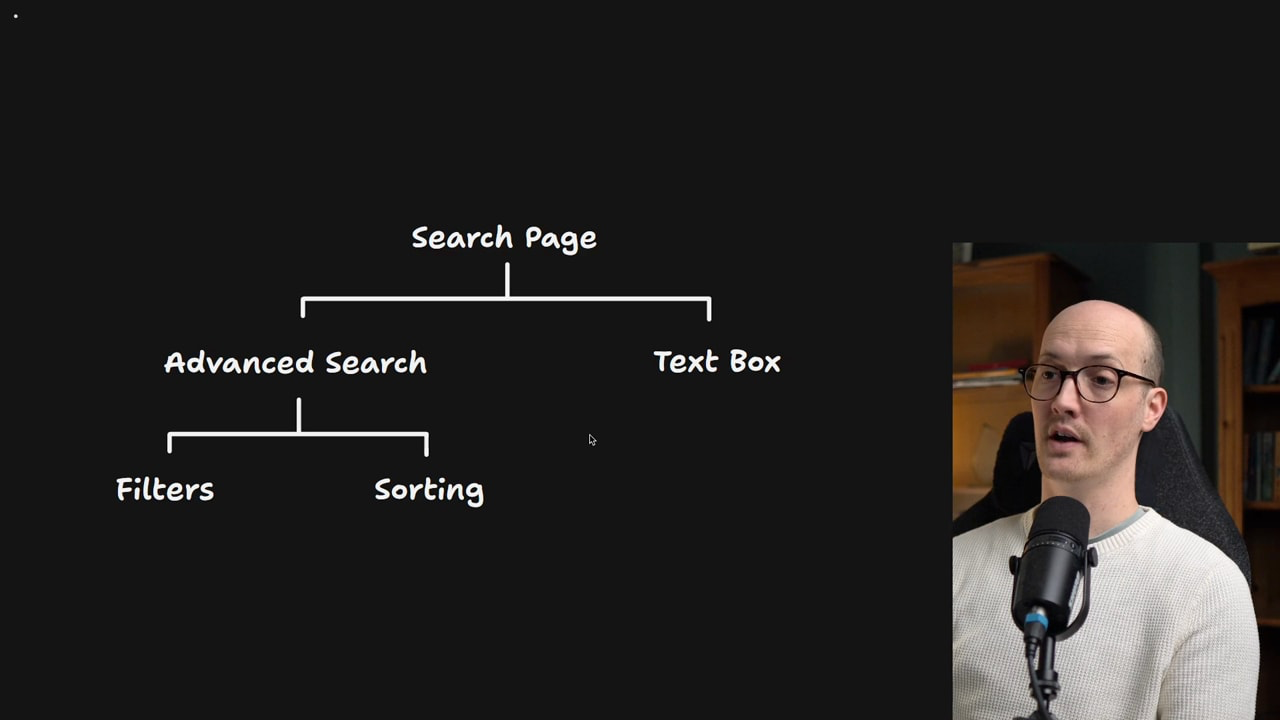
The design tree. Matt credits the idea to a book: "The concept of a "design tree" comes from The Design of Design by Frederick P. Brooks." Each decision opens the next ones, so you walk every branch "until you've fully understood your design before committing to code."
From snapshot/skills/ask-matt/SKILL.md, line 85: “the same relentless interview as /grill-with-docs, but stateless: it saves nothing locally and builds no GLOSSARY.md. Reach for it when you are not working in a working directory (sharpening a plan, a design, a piece of writing, anything with no repo under it).”
A design tree for a search page: advanced search or a text box, from Matt's 2026-03-16 post. From aihero.dev, 30 October 2026.
From grill-me to grilling. In March 2026 the whole Skill was the interview itself. Its body began: "Interview me relentlessly about every aspect of this plan until we reach a shared understanding." By 2026-03-23 Matt had added one line: "I recently added the "provide your recommended answer" line." The point was speed: "you can just say "yes" to the recommendation."
Today a reworded form of that text lives in grilling, which opens "Interview the user relentlessly until you reach a shared understanding." It holds the rules too, including "Word each question so "yes" accepts your recommended answer." So the March post shows the history, and the current files decide how it runs.
The model's own knowledge. Matt's page says the model matters "More than for most skills". Grilling leans on what the model already knows "of how systems break, so use your best one."
The same idea without a Skill. Anthropic's own Claude Code guide gives the bare version: "Ask Claude to interview you instead". Its example is a backend task: "I want to add rate limiting to the public API but haven't thought it through yet." grill-me packs that habit, plus the design tree and the recommended answers, into one typed command.
A real example
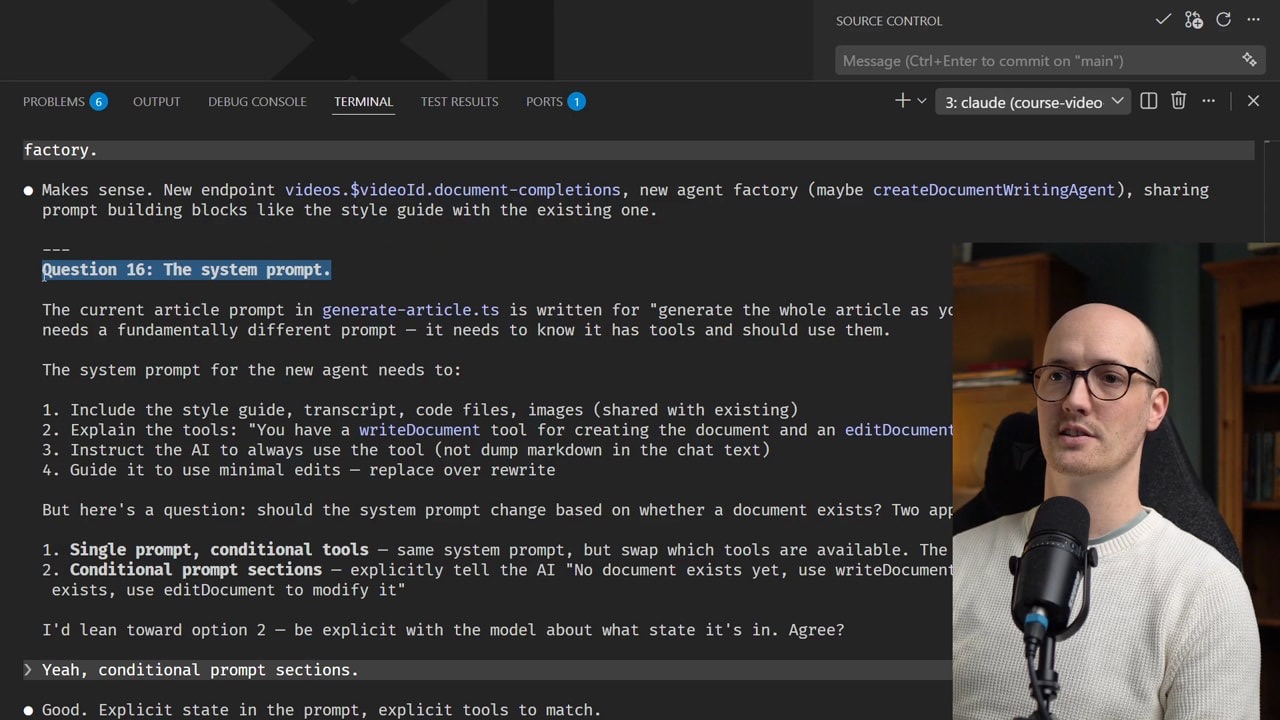
In his 2026-03-16 post, Matt describes a real session: "In one conversation about adding a feature to my course video editor, Claude asked me 16 questions." He calls that short: "I've had sessions lasting nearly half an hour with 30, 40, or even 50 questions on really complex features."
16 interview questions in one grill-me session, from Matt's 2026-03-16 post. From aihero.dev, 30 October 2026.
His page, updated 2026-08-24, counts differently: "Count rounds, not questions. Forty-six questions across four rounds is an ordinary session."
Where it goes wrong
Passivity. Matt's page names the failure mode: "answering "agreed, agreed, agreed" for forty questions and coming out with a plan the agent wrote and you nodded at." The cost: "you decided nothing, and the result looks more certain than it is."
Too many questions. On 2026-04-19 a user opened issue #44, "Codex just asked me 200 questions", asking for a limit. Matt replied on 2026-04-20: "My advice is to remember that you are the one in charge. Use the questions as a prompt to provide more information." And: "It's a conversation, not an exam." The issue was closed as not planned on 2026-04-28. His page now gives the usual cause and fix: "Usually the scope was too large. Ask the agent to break the work into smaller pieces first, then grill each one."
Ungrillable questions. Some questions can't be settled by talk, such as "One long form or three pages?" Matt calls them ungrillable, because "You need something to react to before you can answer them." His advice: "When you hit one, stop grilling. Build the throwaway version with" prototype, "look at it, then come back and answer in one line."
stop grilling
Build the throwaway version
look at it
then come back and answer in one line
When you hit one, stop grilling.
Plan mode. Matt's page says to leave plan mode off: "Plan mode makes the agent hurry to produce a plan, when you want it to keep asking questions."
Clearing too early. Asked whether to start a fresh session before writing the Spec, Matt's page answers "No." The value is the context you just built, so you hand the same conversation straight to to-spec.
A weaker fit with some models. This one is a user's report, not Matt's. On issue #44, on 2026-05-26, a user wrote that GPT in Codex "takes “interview relentlessly” (part of the skill) way too literally, and asks a lot of BS questions", while Claude felt smart to them.
Try it
In your practice project (set it up first with keeping-track's Try it step if you haven't), pick a business decision for the yoga studio that no code depends on yet, such as whether to charge for late cancellations. In a fresh conversation with plan mode off, type /grill-me, give it two or three sentences about the decision, and push back on at least one recommended answer.
Once the decision touches the site's code, that's a job for grill-with-docs.
Going deeper's Check questions are asked in Next up.
“If you are in a working directory, use /grill-with-docs instead: it runs the same interview and leaves a paper trail, so it is strictly the better one.”